
The World's Greatest UFC Card Collection vs My Personal One
I keep two UFC collections in my head: the personal one built on fighters who gave me memories, and the world class one I'm building in public. Here is my logic for the second, and why the base starts with the 2009 and 2010 Topps legends, one single at a time.

I have two UFC collections, and only one of them is allowed to be sentimental. The first is the personal one, the cards I buy because a fighter handed me a memory I never gave back. The second is the one I am actually building in public, the real run at a world class collection, and that one does not always get to care what I felt watching a fight in 2009. For a long time I treated them as the same project. They are not, and untangling the difference is the most useful thing that has happened to my collecting. This is the logic I landed on, written the way I would explain it to a friend who asked why I keep buying old Topps singles instead of ripping the new wax.
Two Collections, One Wall
Let me separate them cleanly, because they run on different rules. My personal collection is emotional on purpose. It is BJ Penn, Rampage Jackson, Chuck Liddell, Georges St-Pierre, and Anderson Silva, the names that made me love this sport in the first place. For those guys I want the scarce stuff, the serial numbered autographs and rookies that cannot be reprinted into oblivion, and I am not trying to be objective about it. That side is the wishlist I am openly chasing, and it is allowed to be biased.
The world class build is a different animal. A genuine top end collection cannot only be the fighters I personally loved. It has to be deep, scarce, and at times completely agnostic of my passion for one name or one era, the kind of collection that makes sense to someone who never watched the fights I watched. When I check where the broader category is actually trending on Card Ladder, I am thinking about the second collection, not the first.
| My personal collection | The world class build | |
|---|---|---|
| Driven by | Memory and loyalty | Scarcity and depth |
| Centerpiece | The fighters I loved | The foundational greats |
| Allowed to be | Biased | Agnostic |
| First real buy | A BJ Penn auto | The 2009 and 2010 base |
My Personal Collection Runs on Memory
This is the easy half to explain, because it is just honest fandom with a budget. I already own the anchor for it, a BJ Penn 2009 Topps certified autograph, an on card signature from before Panini ever touched the license. The Prodigy is a Hall of Famer and one of the first real draws the sport ever produced, so that auto is a hold forever piece for me, never a flip. I want the same thing for Rampage, for the Iceman, for GSP and the Spider: the scarce, signed, numbered version of a fighter I actually have a story about.
I hold these to the same scarcity bar as everything else, I just accept that I will pay a sentiment tax to land the exact names. I already own a Urijah Faber red Disco parallel numbered to 199, and that red and numbered combination is the template for what I want from every legend on this side. Because this era is genuinely old by hobby standards, I price vintage UFC autographs against real sales on 130point before I let emotion set the number.
A World Class Collection Needs a Base
Here is the realization that reorganized everything. You cannot build a tower by starting on the tenth floor. For a long time I was buying whatever name was hot or whatever fighter I happened to love that week, and the result was a pile of cards, not a collection. A real collection has a spine, and the spine of the UFC hobby starts at the beginning, with the first sets the sport ever produced.
So the world class build begins where the cards begin: 2009 and 2010, the Round 1 and Round 2 greats. That is the foundation I am laying before I let myself reach for anything modern. It is deliberately agnostic of my feelings. Some of the most important base cards from that era are fighters I never had a strong opinion on, and they belong in the collection anyway because they were there at the start. When I want to sanity check how the early hobby is being valued as an asset class rather than a nostalgia trip, I read Sports Card Investor.
Why the 2009 and 2010 Topps Greats Are the Foundation
The reason I anchor on these specific years is that Topps launched its UFC program in 2009 and built the hobby's first real footprint with it. That first Topps run is a closed era now, which is exactly why I treat it as finite scarcity, and it is where I start when I map where UFC cards land on the maturity curve. The 2009 Topps UFC Round 1 set is the ground floor, the first major licensed UFC release, and the hero of this post is the card that proves it: a Chuck Liddell rookie, card 5, the Iceman who was the face of the entire first UFC boom. Round 2 followed the same year, and it is where a young Jon Jones turns up on his debut rookie, card 101, before anyone knew what he would become. Then 2010 Topps UFC Main Event arrived as Topps' third UFC product and the next rung up.
What makes this era buildable on a budget is the parallel ladder. The base cards run from an unnumbered Gold, through a numbered Silver, up to a Red one of one, and the hits get genuinely thin from there: the relic parallels drop to 88 copies and the red ink autographs to just 25. That ladder is exactly what I want, because it lets me own real scarcity of a legend without needing the single rarest piece on day one. I pull the checklists and product history for these sets on Cardboard Connection before I trust a print run. I already keep a few of these in hand, including a 2009 Topps GSP fight poster from UFC 87.
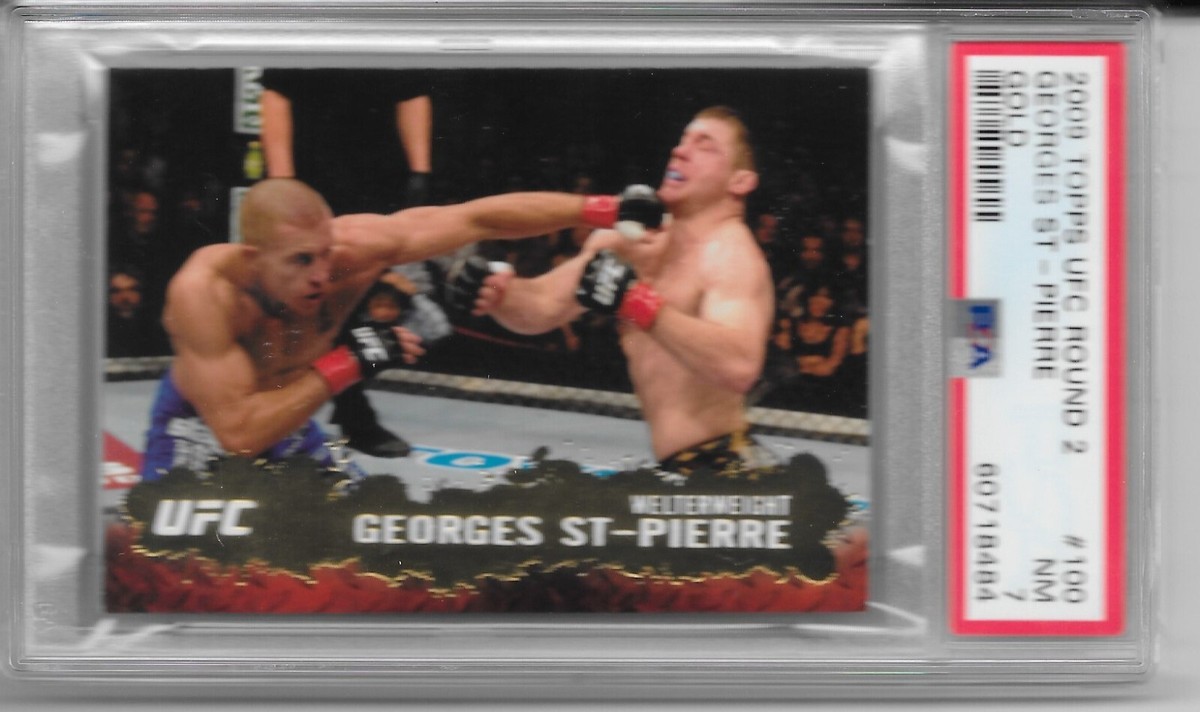
2009 Topps UFC Round 2 Georges St-Pierre, the Gold parallel, card 100, in a PSA 7. Gold sits a tier above base and the slabbed population stays thin. Card: Topps. Image via marketplace listing.
The plan from there is simple to say and hard to do: build the base out of these initial sets, then work forward through the newer sets over time, one rung at a time. A 2010 Main Event card is the next step after the 2009 rounds, and a modern Topps Chrome rookie is a step I have not earned yet on this side of the collection.
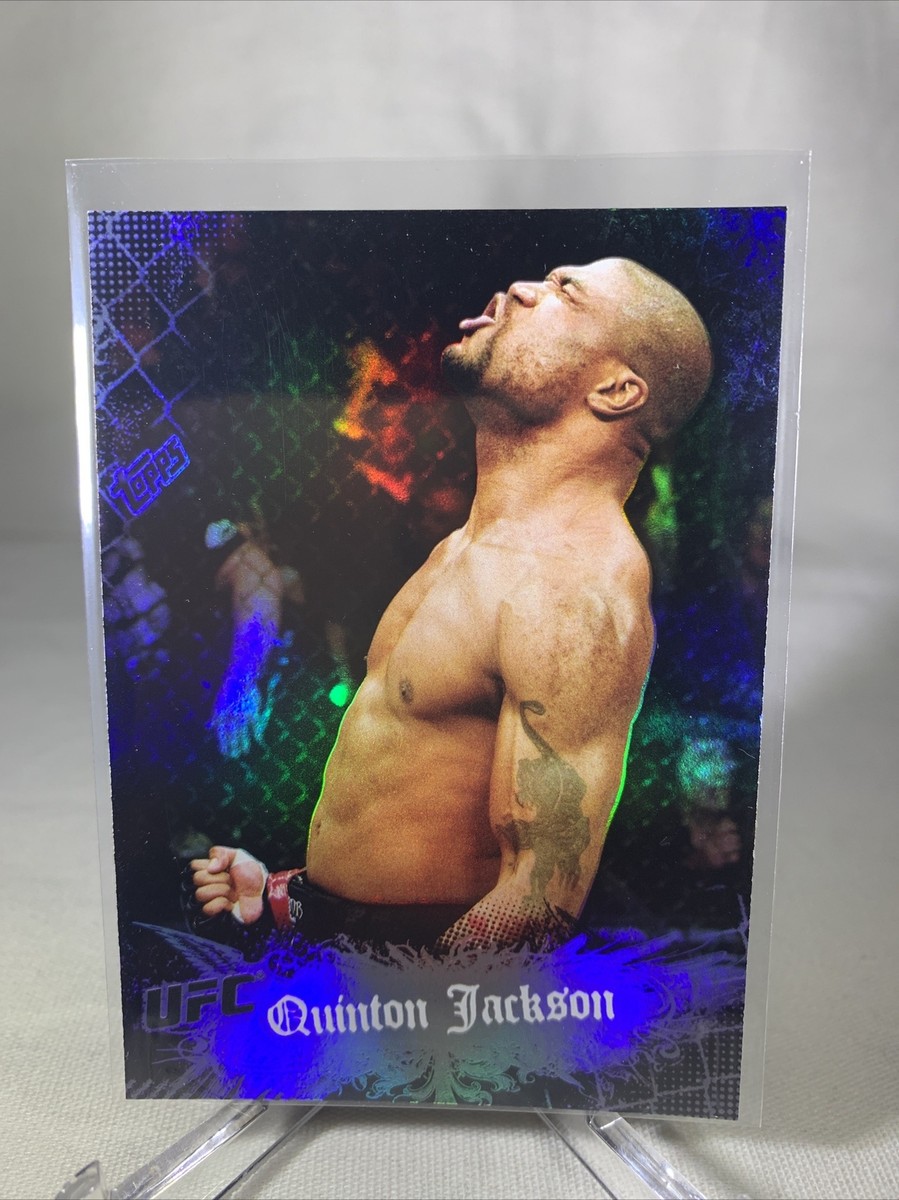
2010 Topps UFC Main Event Quinton "Rampage" Jackson, a Rainbow Holofoil. Main Event was the next rung up from the 2009 rounds. Card: Topps. Image via marketplace listing.
The Red Cards I Can't Afford Yet
Here is the honest financial limit. The card I actually want from this era for a fighter like the Spider is the red ink autograph, a signed parallel with a print run of just 25, and right now I cannot afford it. That is fine. Knowing the ceiling is part of the plan, not a reason to abandon it.
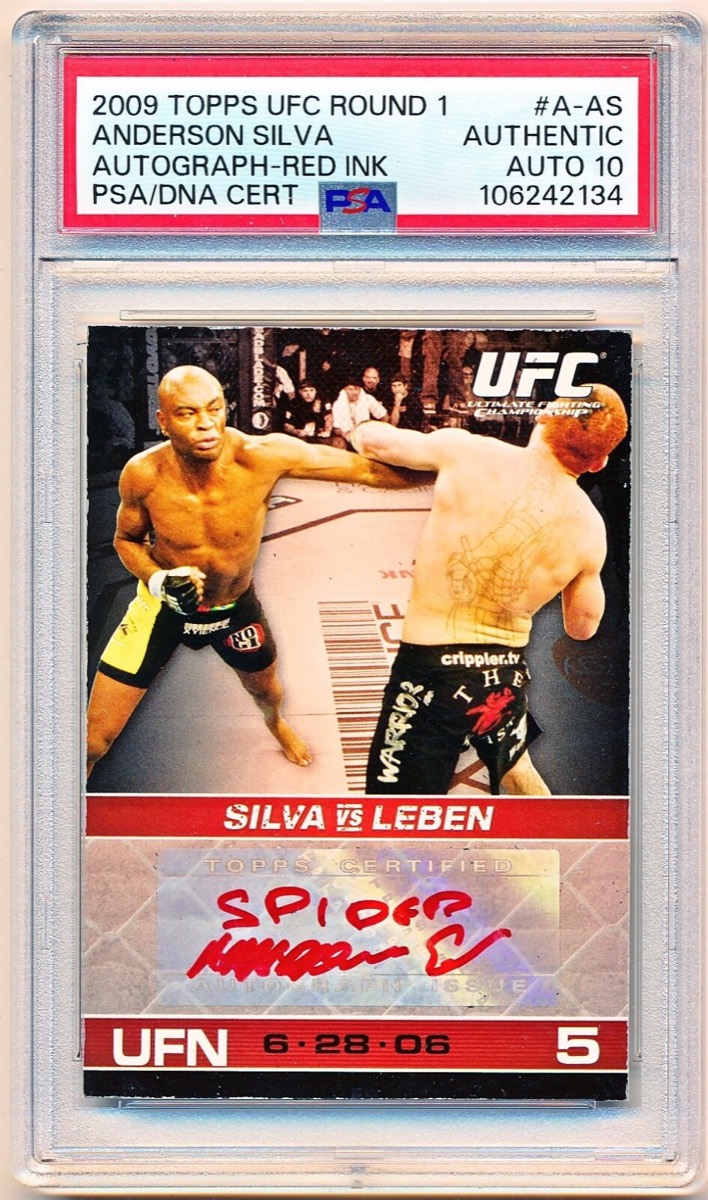
2009 Topps UFC Round 1 Anderson Silva, the red ink autograph, a print run of just 25, PSA/DNA certified. This is the exact tier I cannot afford yet. Card: Topps. Image via marketplace listing.
So instead of stretching for one red signature and stopping, I build on scarcity I can reach and I go deep on specific legendary names first. I would rather own four real Liddell pieces across the parallel ladder than one card I overpaid for in a panic. Depth on a legend now, the red signature later, when the base can support it. Before I add anything I watch the graded population creep on PSA, I price the exact card against eBay sold listings, and for the high end pieces I track auction history on Goldin so I am paying a comp and not a feeling.
Why I Refuse to Rip for This Build
This is the discipline that costs me the most, because I love to rip. Opening wax is the most fun part of the hobby and I am not going to pretend otherwise. But ripping and collection building are two different activities, and confusing them is how people end up with bulk boxes instead of a collection. For the world class build I buy single cards, raw or graded, chosen on purpose. That is the entire method behind my investing thesis: own the fixed supply, not the lottery ticket.
The math is simple. A pack is a bet, a single is a decision. When I want a specific 2009 legend in a specific grade, ripping 2026 product gets me nowhere near it, so I go straight to the card. I keep myself honest by valuing the exact singles I am hunting on Sportscardspro before I commit, never on what a sealed box might cough up.
| What builds the collection | What I treat as entertainment |
|---|---|
| Single cards, raw or graded, bought on purpose | Ripping wax and hoping |
| Numbered autos and rookies of named legends | Base commons by the stack |
| Slabbed legends with thin populations | Bulk lots I will never sort |
| Patient buys in the quiet between releases | Chasing the hot box of the month |
The Bottom Line
Two collections, two sets of rules. The personal one gets to be sentimental, built on the fighters who gave me the memories, paid for in scarce signed numbered cards I will hold forever. The world class build does not get that luxury. It starts at the foundation, the 2009 and 2010 Topps greats, and it works forward through the newer sets one rung at a time, depth before flash, singles over wax, the red signatures earned later instead of forced now. The fun extreme of that same barbell is a prospect like Mauricio Ruffy, bought cheap and early, but the heavy end is always the base. You can watch both halves grow in my collection, one legend and one single at a time. If you want to argue about which 2009 names belong in the foundation, that conversation lives on r/ufc and r/sportscards, and I would genuinely like to hear it.